What Is SEO by HighSoftware99
SEO by HighSoftware99 is a search engine optimization methodology built on Semantic SEO principles. Unlike conventional keyword-centric approaches that target individual search terms in isolation, HighSoftware99 structures every optimization campaign around entities, their attributes, and their contextual relationships within a topical domain.
The methodology originates from information retrieval science — the same discipline that powers Google's ranking algorithms. When Google evaluates a webpage, it does not simply count keyword occurrences. It constructs a semantic understanding of the content by identifying entities (people, organizations, concepts, services), mapping their attributes (properties, characteristics, capabilities), and assessing how comprehensively the content covers the relationships between those entities.
HighSoftware99 applies this understanding through a structured framework that combines four interconnected disciplines: topical authority mapping, entity-driven content architecture, technical performance optimization, and structured data implementation. Each discipline reinforces the others — technical performance ensures Google can efficiently crawl and render the content, while entity-driven architecture ensures the content provides genuine information gain once Google processes it.
The Central Entity Framework
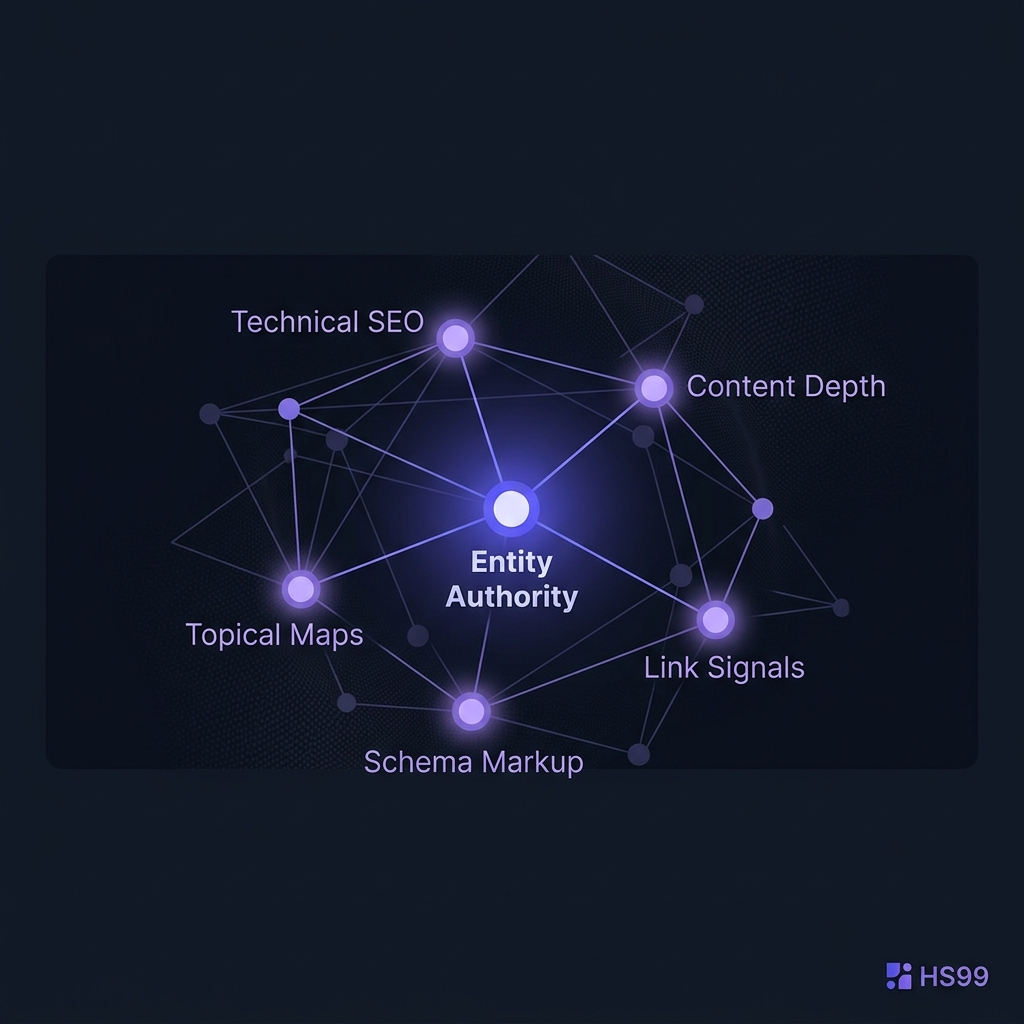
Every HighSoftware99 campaign begins by identifying the central entity — the primary subject that the website needs to establish authority around. For a law firm, the central entity might be "personal injury law." For an e-commerce brand, it might be "sustainable running shoes." HighSoftware99 then maps all related sub-entities, attributes, and contextual relationships to build a complete topical map.
This topical map becomes the architectural blueprint for the entire website. Each page targets a specific entity cluster within the map. Internal links connect related entity clusters through semantic annotation blocks that provide contextual relevance signals to search engine crawlers. The result is a website that demonstrates comprehensive expertise on a subject — exactly what Google's Helpful Content system rewards.
How Our Semantic SEO Framework Works
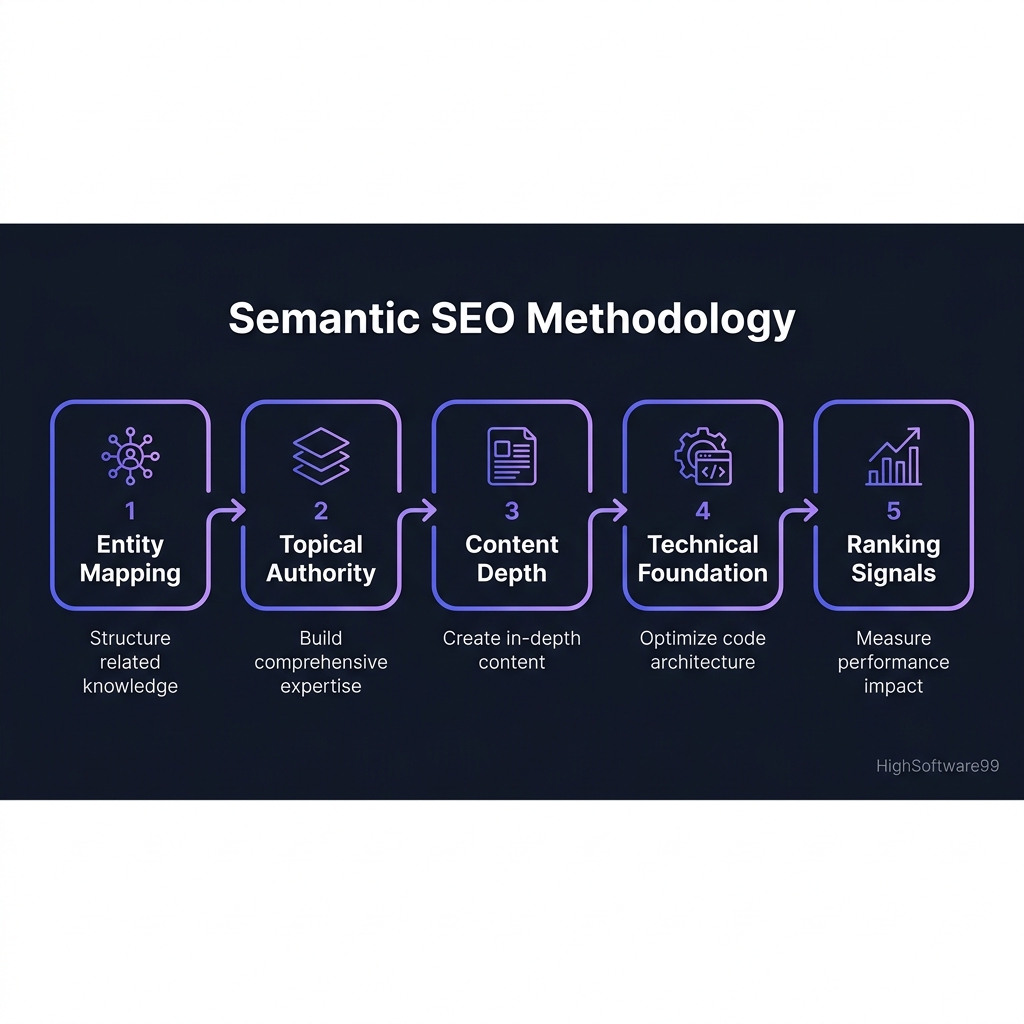
HighSoftware99's Semantic SEO framework operates through five sequential phases. Each phase builds upon the previous one, creating compound ranking improvements that accelerate over time.
Phase 1: Entity Mapping and Topical Authority Planning
HighSoftware99 begins every engagement by constructing a comprehensive entity map for the target domain. This map identifies the central entity, all related sub-entities, their attributes, and the semantic relationships connecting them. The entity map directly informs the website's content architecture — determining which pages to create, how to structure internal links, and where to place contextual annotation blocks.
Entity mapping is the most critical phase because it prevents the two most common SEO failures: keyword cannibalization (multiple pages competing for the same query) and topical gaps (missing content that Google expects to find on an authoritative source). HighSoftware99 uses proprietary entity mapping workflows that analyze competitor content coverage, search intent patterns, and Google's Knowledge Graph connections to build maps that cover 100% of the relevant topical territory.
Phase 2: Content Depth Through Entity-Attribute-Value Authoring
HighSoftware99 authors every content asset using an Entity-Attribute-Value (EAV) framework. Each paragraph serves a specific purpose within the semantic structure: it either defines an entity, describes an attribute of that entity, or establishes a relationship between entities. This eliminates filler content — every sentence provides genuine information gain.
The EAV authoring framework produces content that reads naturally to humans while simultaneously providing maximum semantic signal density to search engine natural language processing pipelines. HighSoftware99 enforces declarative, active-voice writing across all published assets to reduce ambiguity in Google's content parsing.
Phase 3: Technical Foundation — Performance That Enables Ranking
Content quality alone does not produce rankings if the technical infrastructure prevents Google from efficiently accessing and processing that content. HighSoftware99 enforces four measurable technical standards on every page:
- Time to First Byte (TTFB) under 200 milliseconds — achieved through Cloudflare edge rendering and server-side optimization
- DOM node count under 1,200 elements — reducing Google's cost of retrieval and accelerating rendering
- Cumulative Layout Shift (CLS) of 0.00 — ensuring visual stability that improves both user experience and Core Web Vitals scores
- Largest Contentful Paint (LCP) under 2.5 seconds — guaranteeing the primary content loads within Google's performance threshold
These technical standards are not aspirational targets — they are enforced requirements. HighSoftware99 audits every page against these benchmarks before deployment and monitors them continuously through Google Search Console and synthetic testing.
Phase 4: Structured Data and Schema Markup Implementation
HighSoftware99 implements JSON-LD structured data on every page to explicitly communicate entity relationships to search engines. Schema types include Organization, WebSite, Article, FAQPage, BreadcrumbList, ProfessionalService, and SoftwareApplication — each precisely configured to match the page's semantic content.
Structured data serves two functions: it enables rich result eligibility (FAQ dropdowns, sitelinks, knowledge panel entries) and it reinforces the semantic signals already present in the HTML content. HighSoftware99 treats schema markup as a confirmation layer — the structured data should mirror what the content already communicates, not introduce new information.
Phase 5: Authority Building Through Contextual Link Acquisition
HighSoftware99 acquires backlinks through contextual relevance rather than volume. Every link acquisition targets sources that are semantically related to the client's topical domain. A backlink from a relevant industry publication carries significantly more ranking weight than dozens of links from unrelated directories.
Internal linking follows the same contextual relevance principle. HighSoftware99 wraps every internal link in a semantic annotation block — a paragraph of contextual content that explains the relationship between the linking page and the target page. This annotation provides Google with explicit context for the link, increasing the PageRank transfer efficiency and reinforcing topical relationships.